
Opening the Scriptures Orthodox Bible Study

Your Presenter
Dean of Holy Cross and Archbishop Demetrios Professor of Biblical Studies and Christian Origins
Rev. Eugen J. Pentiuc, Dean of Holy Cross Greek Orthodox School of Theology and Archbishop Demetrios Professor of Biblical Studies and Christian Origins, joined Holy Cross in 1998 and became tenured professor of Old Testament and Semitic languages in 2009. Fr. Pentiuc served Holy Cross as Associate Dean for Academic Affairs (2014–2018). He is also a Protopresbyter of the Ecumenical Throne.
About the Program
Opening the Scriptures is a weekly Bible Study offered every Thursday at 7:00 PM Eastern via Zoom.
Join us as we open the Scriptures through the insights of modern biblical scholarship and the living interpretive tradition of the Orthodox Church, especially the Fathers, Byzantine liturgy, and the spiritual and pastoral wisdom of the biblical text.
Part of The Scriptorium Initiative at Holy Cross, funded by Lilly Endowment, this Bible Study is open to everyone: seminarians, clergy, faithful, seekers, and all who wish to discover more deeply how Scripture is read, interpreted, and lived within the Orthodox tradition.
WHEN
Every Thursday
TIME
7:00–8:00 PM, Eastern
WHERE
Live via Zoom
REGISTRATION
Free, open to everyone
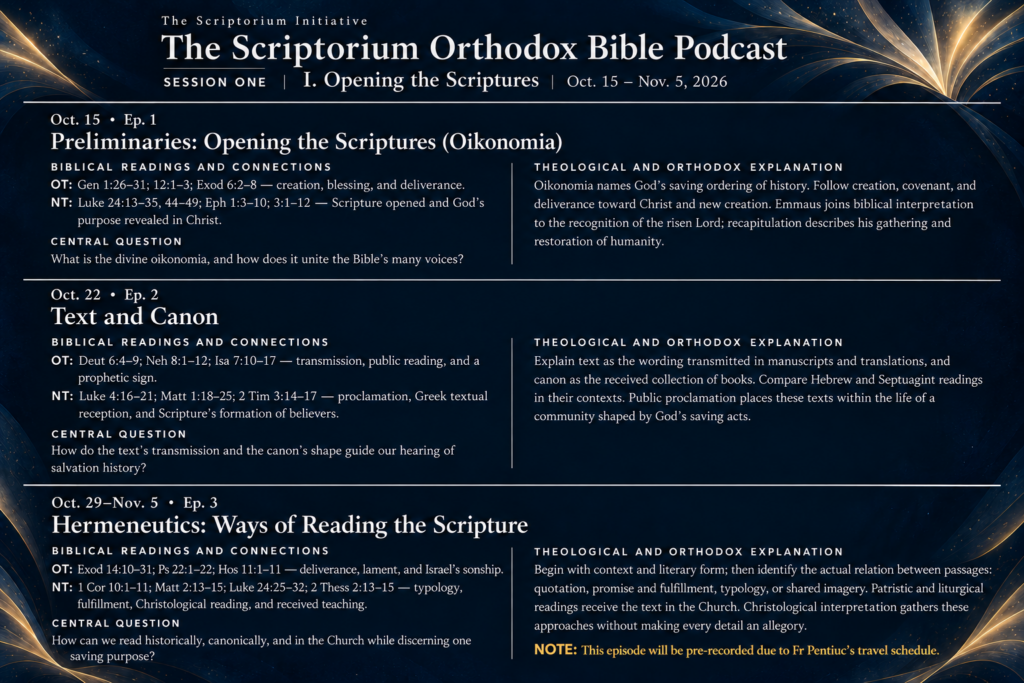
Session One Schedule
Opening the Scriptures
Preliminaries: Opening the Scriptures (Oikonomia)
Biblical readings and connections
OT: Gen 1:26–31; 12:1–3; Exod 6:2–8 — creation, blessing, and deliverance.
NT: Luke 24:13–35, 44–49; Eph 1:3–10; 3:1–12 — Scripture opened and God’s purpose revealed in Christ.
Central question
What is the divine oikonomia, and how does it unite the Bible’s many voices?
Theological and Orthodox explanation
Oikonomia names God’s saving ordering of history. Follow creation, covenant, and deliverance toward Christ and new creation. Emmaus joins biblical interpretation to the recognition of the risen Lord; recapitulation describes his gathering and restoration of humanity.
Text and Canon
Biblical readings and connections
OT: Deut 6:4–9; Neh 8:1–12; Isa 7:10–17 — transmission, public reading, and a prophetic sign.
NT: Luke 4:16–21; Matt 1:18–25; 2 Tim 3:14–17 — proclamation, Greek textual reception, and Scripture’s formation of believers.
Central question
How do the text’s transmission and the canon’s shape guide our hearing of salvation history?
Theological and Orthodox explanation
Explain text as the wording transmitted in manuscripts and translations, and canon as the received collection of books. Compare Hebrew and Septuagint readings in their contexts. Public proclamation places these texts within the life of a community shaped by God’s saving acts.
Hermeneutics: Ways of Reading the Scripture
Biblical readings and connections
OT: Exod 14:10–31; Ps 22:1–22; Hos 11:1–11 — deliverance, lament, and Israel’s sonship.
NT: 1 Cor 10:1–11; Matt 2:13–15; Luke 24:25–32; 2 Thess 2:13–15 — typology, fulfillment, Christological reading, and received teaching.
Central question
How can we read historically, canonically, and in the Church while discerning one saving purpose?
Theological and Orthodox explanation
Begin with context and literary form; then identify the actual relation between passages: quotation, promise and fulfillment, typology, or shared imagery. Patristic and liturgical readings receive the text in the Church. Christological interpretation gathers these approaches without making every detail an allegory.
This episode will be prerecorded due to Fr. Pentiuc’s travel schedule.